Continuous Monitoring for Stationary VRLA, VLA and Ni-Cd Batteries
In critical power systems, stationary batteries support continuity during utility failures and transfer events.
Because individual battery degradation can remain hidden at string level, continuous monitoring is required to
improve visibility, reduce risk and support informed maintenance decisions.
Alpais Battery Monitoring System monitors individual batteries, complete strings and environmental conditions
in real time. It supports VRLA, VLA and Ni-Cd battery systems, including 2V, 6V and 12V lead-acid batteries and
1.2V nickel-cadmium cells.
One Alpais system can monitor up to 480 batteries. The
system architecture
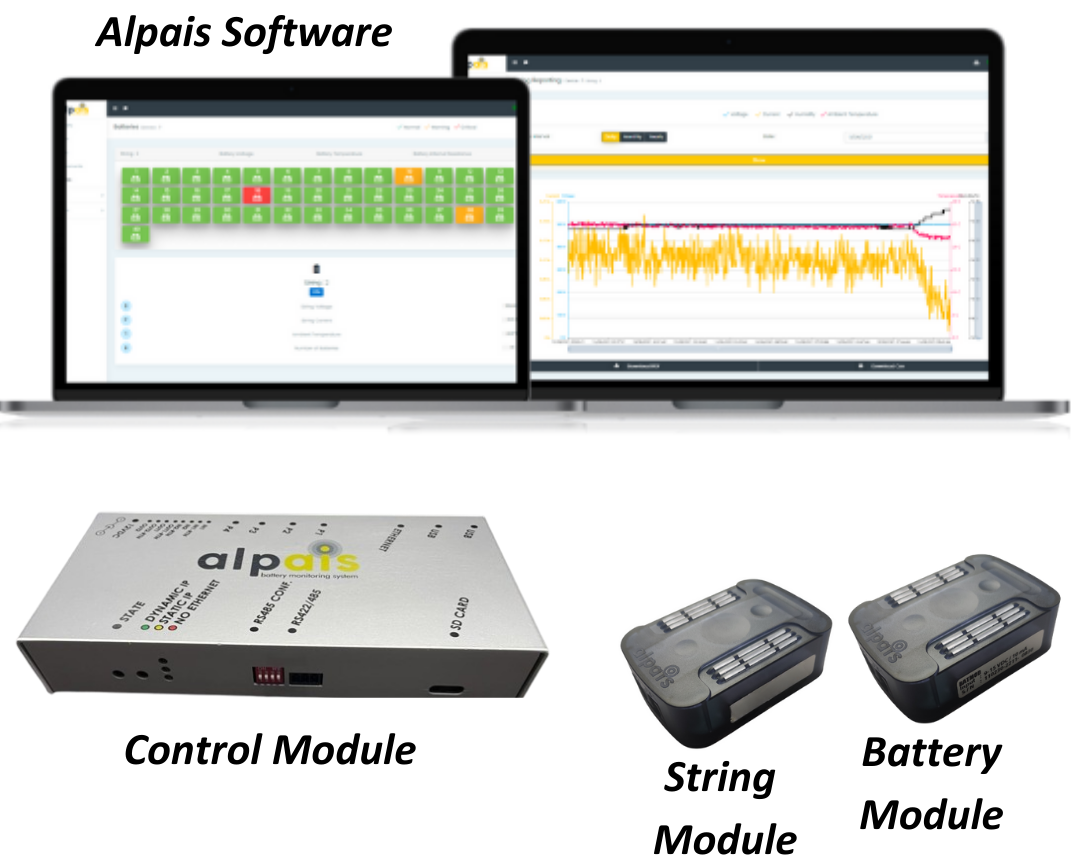
consists of three main hardware components: Battery Module, String Module and Control Module.
The modular structure of Alpais BMS supports scalable battery monitoring for a wide range of stationary battery systems:
- 1 Battery Module for each battery/cell
- 1 String Module for each string
- 1 Control Module for each location, up to 4 strings
- 1 String Module for up to 120 Battery Modules connectivity
Alpais BMS supports stationary battery applications in UPS systems, data centers, utilities, substations,
telecom infrastructure and industrial facilities. It provides real-time measurements, alarms, historical
records and remote access through a flexible
battery monitoring architecture
.
Application-specific information is available on the
Battery Monitoring Applications
page, including a dedicated
Data Center Battery Monitoring System
page.
Why Alpais Battery Monitoring Solutions?
- Continuous measurement with historical records
- Automatic event notifications for users
- Charge and discharge event records
- Individual battery voltage, temperature, and internal resistance values
- Optional battery voltage balancing
- Extended-capacity arrangements for strings with more than 120 batteries
- Automatic addressing for faster and easier installation
- Unlimited users with different authorization levels
- Monitoring of multiple locations from one single screen
Alpais BMS continuously measures the key parameters required to evaluate battery condition and long-term
performance trends. It records internal resistance, battery voltage and battery temperature for each individual
battery, while also monitoring string voltage, string current, charge and discharge behavior, ambient temperature
and ambient humidity.
Alpais Battery Monitoring System can store up to 10 years of historical data for long-term analysis and maintenance planning.
Measured Parameters

Battery Voltage

Battery Temperature

Internal Resistance

String Current
Charge / Discharge Behavior

Ambient Temperature

Ambient Humidity

String Voltage
Alpais Software provides real-time monitoring, remote access, event logs, and reporting in PDF and CSV formats for selected time periods. The system owner can add unlimited users and configure who will receive notifications.
Try Alpais Software Live Demo
Alpais Battery Monitoring System supports two notification levels: Warning and Critical. This helps users respond earlier, plan maintenance actions more effectively, and manage both time and budget with better visibility.
Flexible deployment: Alpais can operate with a company server, a cloud server, or a Control Module with an embedded server. In the embedded server option, Alpais Software is pre-installed and runs directly on the Control Module, where historical data is also stored.
Alpais Battery Voltage Balancing
The
Battery Voltage Balancing
feature supports a more even voltage distribution among batteries in the same string and helps
reduce the effects of persistent overcharge and undercharge conditions.


By regulating individual battery voltages within the configured limits, Alpais Battery Voltage
Balancing supports more stable string behavior and can assist maintenance teams in managing
persistent voltage imbalance.
The balancing function is optional and should be configured according to the battery type,
charging system and project requirements.
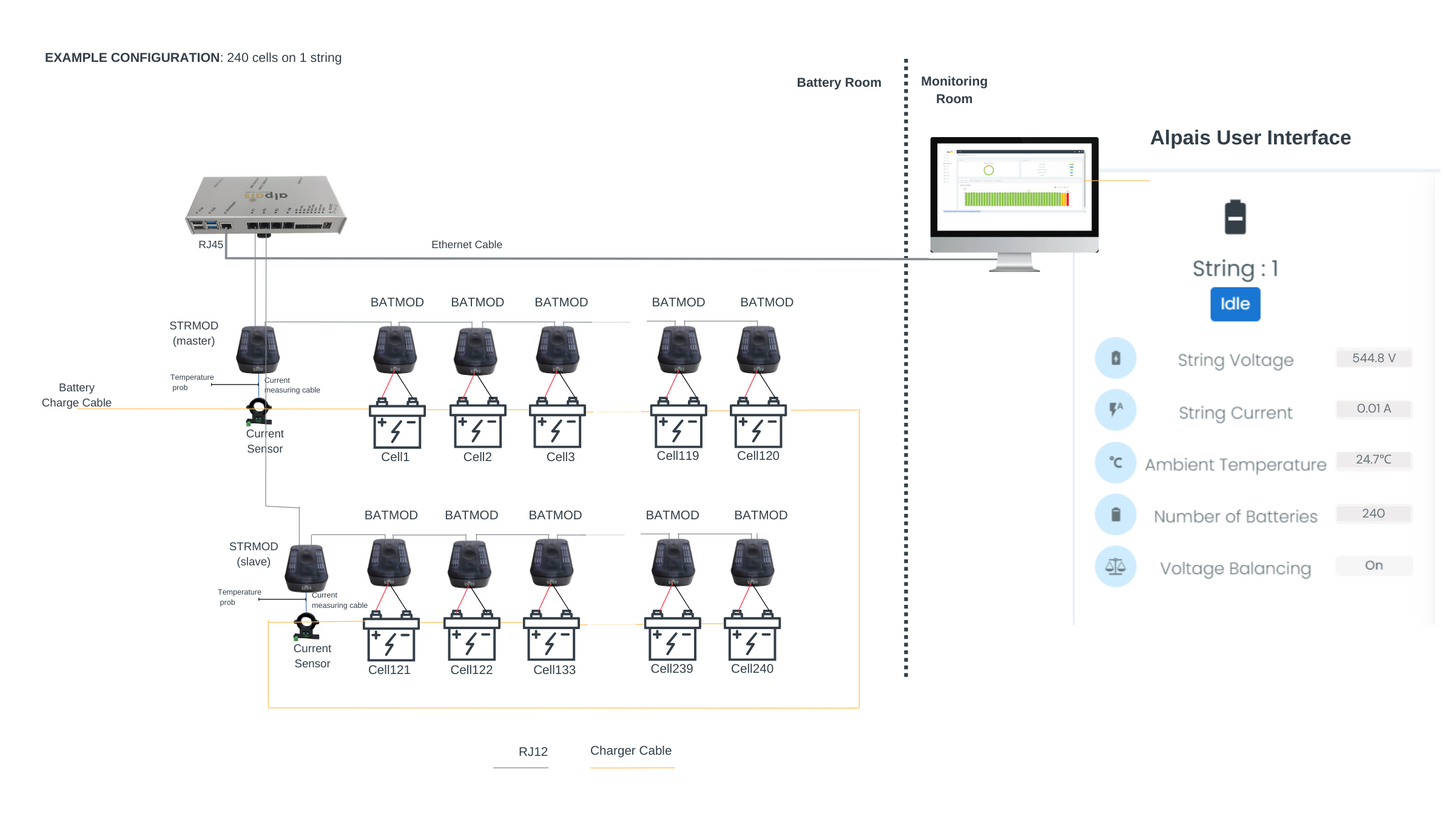
Extended Capacity for Long Battery Strings
Some industrial, UPS, data center and Ni-Cd applications use battery strings containing more than
120 batteries or cells. One String Module supports communication with up to 120 Battery Modules.
For longer strings, additional String Modules can be integrated within the same monitoring
architecture and displayed through the same Alpais software interface.
This scalable arrangement allows up to 480 cells to be monitored in a single long-string
configuration, subject to the approved project architecture and communication design. See the
system architecture
page for the main hardware structure.
Additional Monitoring Options for Industrial Battery Applications
Industrial battery projects may require monitoring beyond the standard battery and string
parameters. Depending on the site requirements, Alpais can be extended with
DC ground fault detection
for fault visibility in the DC system,
hydrogen gas monitoring
for battery-room conditions, and low-electrolyte level monitoring for applicable battery types.
Alpais BMS Industrial Solutions
Alpais can provide additional solutions, communication options and accessories according to the
project architecture and application requirements:
These optional components can be integrated into battery monitoring solutions according to
project requirements and application needs. For application-specific configurations, review the
Industrial Battery Monitoring Solutions
page.
Explore Alpais Software and Monitoring Interface